
Uber: solid business, demanding valuation

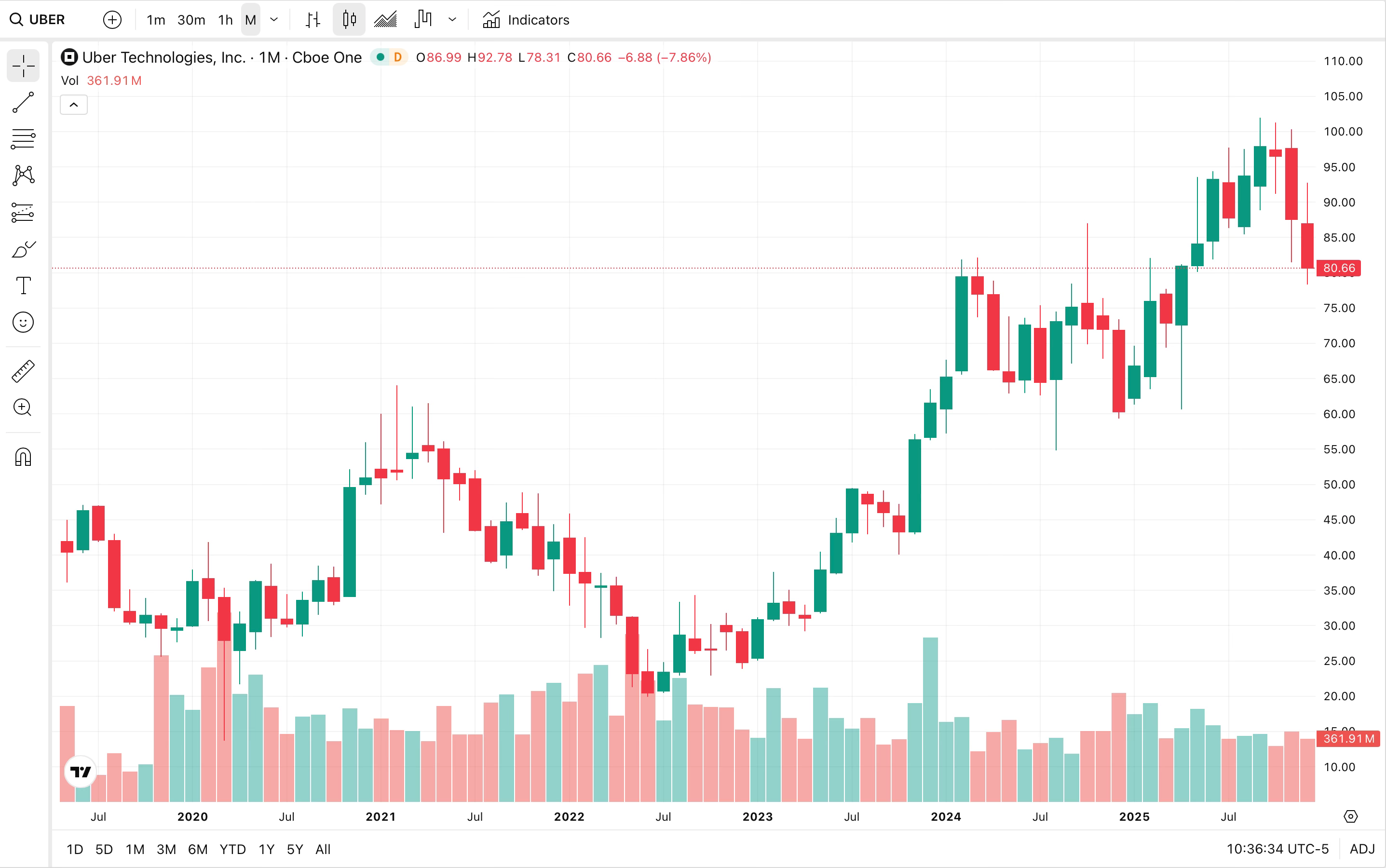
Uber operates in one of the most competitive and fragmented global markets, where scale, execution speed, and operational efficiency matter more than technological novelty or headline innovation. Mobility, delivery, and logistics are not new industries. What differentiates players is the ability to coordinate supply and demand efficiently, across geographies, at scale.
Despite persistent competitive pressure, Uber has continued to deliver double-digit revenue growth while progressively expanding margins. This improvement has been driven by pricing discipline, tighter cost control, and better operating leverage rather than aggressive incentive spending.
At the same time, the company remains structurally exposed to regulatory and labor-related risks, which represent a recurring constraint on long-term margin visibility and cash flow durability.
Business overview
Uber is a global mobility and delivery platform operating in more than 70 countries, connecting consumers with independent drivers, couriers, and merchants through a technology-enabled marketplace.
The business is organized around three main segments:
Mobility: the most mature and established segment, representing the core earnings engine.
Delivery: a faster-growing segment focused on food and local commerce, with improving but still more variable profitability.
Freight: a smaller digital freight brokerage operation, currently non-core to the overall investment case.
Uber operates an asset-light, platform-based model. It does not own vehicles nor directly employ drivers. Instead, it facilitates transactions and earns revenue primarily through commissions and service fees. This structure allows the platform to scale with limited capital intensity, but it also increases exposure to regulatory frameworks governing labor classification and pricing.
Key operating metrics (high level)
Some indicators help frame the current state of the business:
Revenue has grown at a mid-20% CAGR over the past five years, normalized for Covid-related distortions.
Operating margins have reached high single digits on a trailing twelve-month basis.
Free cash flow margins are now solidly positive, reflecting improved operating discipline.
Liquidity remains adequate, with cash covering more than one year of trailing operating cash flow.
Monthly active platform consumers stand at ~189 million, growing at a mid-teens rate year over year.
Gross bookings continue to expand at low-20% YoY, indicating sustained demand across core segments.
Overall, Uber has transitioned from a growth-at-all-costs model to a more balanced phase where profitability and cash generation matter.
Industry and competitive positioning
Uber operates a large-scale, multi-vertical marketplace where competitive differentiation is driven primarily by:
Network scale and marketplace liquidity
Cross-platform synergies between Mobility and Delivery
Data-driven demand forecasting and supply optimization
The breadth of the platform allows Uber to reuse demand, data, and infrastructure across verticals, improving utilization and efficiency.
However, the competitive environment remains structurally challenging:
Switching costs for both consumers and drivers are low
Competition is intense and often local
Regulation varies significantly across jurisdictions
As a result, Uber’s positioning requires constant execution discipline to balance growth, incentives, and margin sustainability.
Potential catalysts
Looking forward, several factors could influence operating performance:
Sustained free cash flow generation and incremental margin expansion, driven by pricing discipline, efficiency gains, and reduced promotional intensity.
Increased advertising monetisation, leveraging Uber’s large user base and data assets, with limited incremental costs and structurally high margins.
Expansion of retail and grocery partnerships within Delivery, supporting higher order frequency and basket size, albeit with a more modest margin impact than Mobility.
Longer-term adoption of autonomous vehicle networks through partnerships, representing upside optionality rather than a base-case assumption, given technological and regulatory uncertainty.
Key risks
The investment case remains exposed to several structural risks:
Intense competition and low switching costs, which can pressure pricing, incentives, and margins across all segments.
Regulatory and labor classification risk, particularly the potential reclassification of drivers as employees or quasi-employees, which could materially alter cost structures.
Execution risk around autonomous vehicle integration, where delayed adoption or superior competitor solutions could limit long-term optionality.
Broader legal and regulatory exposure across multiple jurisdictions, including pricing practices, data usage, and local operating restrictions.
Several of these risks are structural rather than cyclical and may persist regardless of near-term operating performance.
Valuation considerations
From a valuation perspective, both discounted cash flow analysis and relative multiples suggest that current market pricing embeds optimistic assumptions:
Continued margin expansion across core segments
Sustained above-trend growth in Mobility and Delivery
Favorable regulatory outcomes over time
On a relative basis, Uber trades at a clear premium to peers such as Lyft, reflecting superior scale, platform diversification, and stronger long-term cash flow expectations. At the same time, this premium implies higher execution requirements and limited tolerance for disappointment.
In other words, the valuation leaves little room for operational or regulatory setbacks.
Final thoughts
Uber today represents a business with improving profitability dynamics, strong platform scale, and clearer operating discipline than in the past. At the same time, it remains exposed to structural regulatory and competitive constraints that limit long-term visibility.
Current valuation levels reflect a constructive outlook on growth and margins, making the risk-reward profile increasingly sensitive to execution quality and regulatory developments. Uber remains a solid business, but at a price that demands consistency rather than forgiveness.
This article is for informational and educational purposes only and does not constitute investment advice. All analysis is based on publicly available information and forward-looking assumptions that may prove inaccurate.